
AN Australian-first microplastic assessment has found three Mid North Coast creeks to be among NSW’s most contaminated coastal waterways.
The NSW Environment Protection Authority (EPA) has partnered with the NSW Department of Climate Change, Energy, the Environment and Water (DCCEEW) to deliver a Broadscale Microplastic Assessment, released this week.
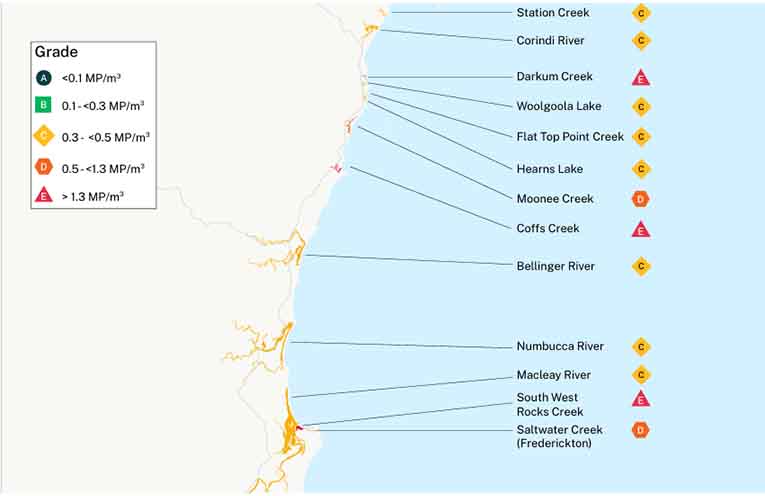
The report ranks coastal waterways by microplastic concentration in the top 15 centimetres of surface water, from most to least contaminated (Grade E being the most contaminated).
Coffs Creek and South West Rocks Creek were listed in the state’s top 10 hotspots, most of which were in the greater Sydney region.
Darkum Creek (Mullaway) was also identified as scoring an E Grade for contamination.
The report card stated that the North Coast region exhibited “moderate to high microplastic contamination”.
Across 17 waterways and 67 samples, most North Coast systems fell within Grade C, with no waterways graded A or B and three systems graded E.
“Localised hotspots were found at Darkum Creek, Coffs Creek and South West Rocks Creek, all in highly disturbed catchments and among the most contaminated waterways in New South Wales,” the report card states.
“While some systems showed high variability, overall patterns indicate that smaller, urbanised waterways drive elevated contamination in this region.”
The comprehensive three-year (2021-24) study will help environment authorities understand how microplastics end up in waterways and where to focus further research.
NSW EPA Chief Executive Tony Chappel said the results will provide important insights to guide future work.
“Microplastics are one of the fastest-emerging threats to marine life and our environment, often washed from land into rivers and then into the ocean through stormwater drains,” Mr Chappel said.
“For the first time, we’ve sampled 120 catchments from the Tweed to the Victorian border to identify the most affected sites, the types of microplastics present, and where we can make the greatest impact.
“Microplastics were detected in every waterway sampled, demonstrating the widespread nature of plastic contamination across urban, regional, and remote catchments.”