
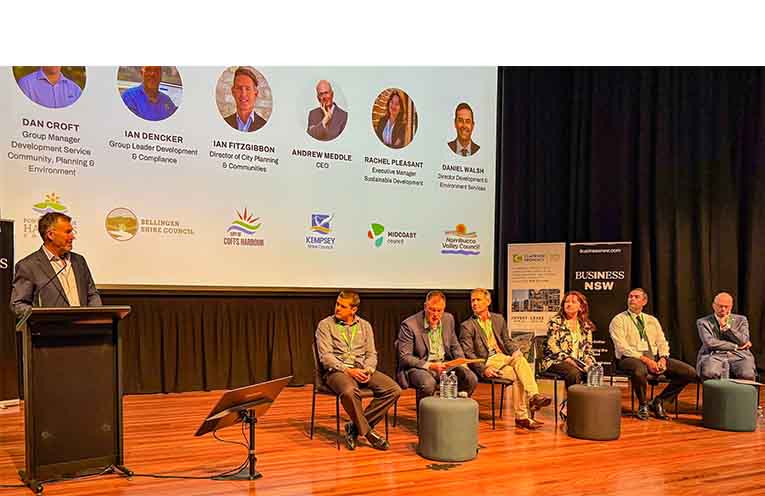
A STRONG call for greater infrastructure investment to unlock housing supply in regional areas was delivered by Nambucca Valley Council at a housing summit in Coffs Harbour.
Council representatives attended the Business NSW Mid North Coast Housing Summit on 1 May, joining leaders from government, industry and local councils to examine housing challenges and the impact of recent NSW Government planning reforms.
The summit, organised by Business NSW Mid North Coast, focused on the growing gap between housing demand and supply across regional communities.
Business NSW’s Rod Barnaby said the forum reinforced concerns raised by businesses about the current housing system.
“We heard that regional infrastructure is the biggest single issue impacting housing supply, which is now a core economic constraint for regional businesses,” he said.
“Other issues include coordination across different levels of government, addressing workforce shortages in planning, the cost of accreditation, certification and delays in approval, and the ‘missing middle’ typologies needed to meet the needs of regional markets.”
Nambucca Valley Council Director of Development and Environment Services Daniel Walsh was among those participating in a panel discussion at the summit.
Mr Walsh told attendees that while planning reform is a positive step, it will not on its own deliver the housing outcomes required in regional areas.
“We welcome the NSW Government’s focus on planning reform, however they do not go far enough and the reality for regional councils is that housing supply is constrained not just by planning, but by the availability of essential infrastructure,” he said.
“Nambucca Valley is well positioned to support population growth and deliver new housing, but we need infrastructure investment to unlock that potential and ensure development can proceed in a timely and sustainable way.”
During the discussion, Mr Walsh highlighted the importance of investment in essential services such as water, sewer, roads and supporting infrastructure to make development-ready land viable.
He pointed to Council’s Valla Urban Growth Area as a key example, where land directly controlled by Council could deliver around 140 new homes, with more than 500 additional dwellings potentially available across the broader precinct on privately owned residential land.
It was also noted that despite planning reforms, the number of development applications in the system has not decreased and ongoing workforce shortages across the state are likely to limit any significant reduction in approval timeframes.
Council has reaffirmed its commitment to advocating for targeted funding and stronger alignment between policy and infrastructure delivery to ensure regional communities can play a meaningful role in addressing Australia’s housing challenges.
By Mick BIRTLES