
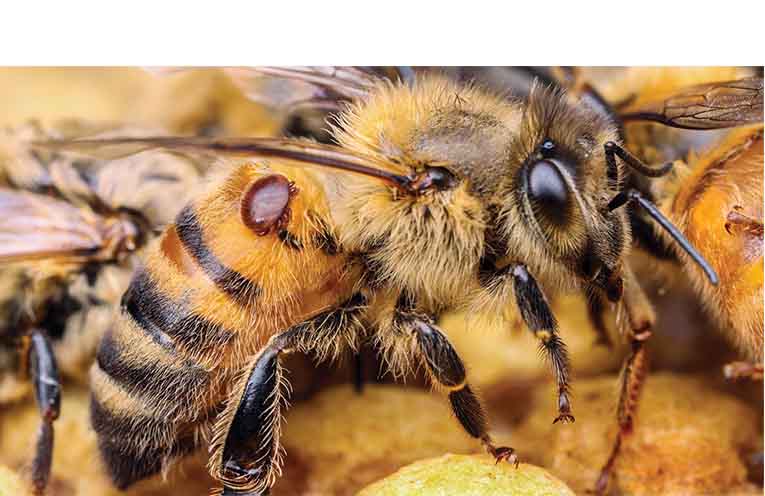
NEW research unveiled at a major industry conference has shown how a naturally occurring fungi may help beekeepers combat Varroa mites, one of the world’s most destructive honeybee parasites.
Attendees at the 2026 Australian Almond Conference have learnt that researchers are developing a biological control for Varroa destructor, the mite that attacks honeybee colonies and threatens the pollination that underpins the country’s agriculture.
The project is investigating Metarhizium – a naturally occurring fungus that can infect and kill Varroa mites while remaining safe for honeybees.
“Our goal is to develop a safe, affordable biological control that works with nature, not against it,” said the project’s chief investigator, Associate Professor Fleur Ponton, from Macquarie University’s School of Natural Sciences.
The research comes at a critical time for Australia’s beekeeping and agricultural industries: Varroa was first detected in Australia in NSW in 2022 and has since spread to several states, putting a growing strain on the country’s pollination systems.
Current Varroa management relies heavily on chemical treatments. However, some resistance to chemicals has been detected in Queensland and NSW, highlighting the urgent need for alternative approaches.
Our early results show that fungi could provide a promising new way to control Varroa mites, one of the biggest threats facing honeybees. In initial tests, the fungal strains killed high numbers of Varroa mites.
The scientists are now working to identify a concentration that can effectively kill Varroa mites while remaining safe for honeybees.
The stakes extend well beyond the production of honey. Honeybees provide essential pollination services for a range of agricultural crops, including Australia’s $1.3 billion almond industry.
This year, concerns over bee numbers and hive availability have seen thousands of beehives transported from Western Australia to South Australia to help meet pollination demand.
“The almond industry has already experienced significant pollination cost increases since Varroa arrived. It is a slow-moving biosecurity trainwreck that requires immediate support to underpin the viability of beekeepers and pollination-dependent industries,” said Tim Jackson, CEO of the Almond Board of Australia.
“Around one in three things Australians eat need a bee to produce. The long-term ramifications cannot be understated.”
If future field tests are successful, the newly developed treatment will offer beekeepers a safer, more sustainable form of hive protection.
For Associate Professor Ponton, the challenge is to protect Australia’s food production resilience.
“Healthy honeybees are fundamental to so much of our agricultural system. We need to be thinking now about what sustainable Varroa management looks like in five, 10 and 20 years.”