
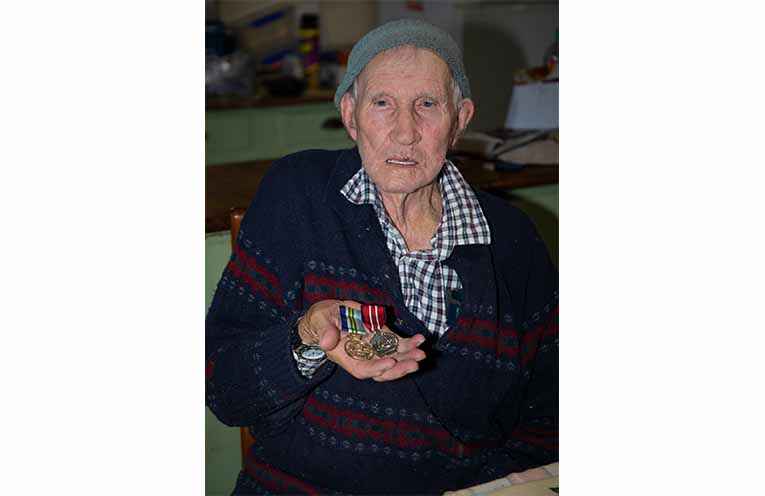
AFTER more than 70 years of waiting, 93-year-old Nambucca Valley resident and Royal Australian Air Force (RAAF) veteran Kevin Blanch has finally received the medals recognising his military service, including his involvement in Britain’s first atomic bomb test in 1952.
For Mr Blanch, who had long given up hope of receiving formal recognition, the arrival of his medals brought a mixture of delight, relief and satisfaction that his contribution to Australia’s military history had finally been acknowledged.
The extraordinary delay appears to have resulted from an administrative mix-up involving government departments, with Mr Blanch’s identity seemingly confused with that of one of his brothers.
It was through the persistence of his family, particularly his granddaughter in Adelaide, that the matter was eventually resolved, bringing an end to more than seven decades of waiting.
He enlisted in the RAAF in 1950, following in the footsteps of his two brothers who had already joined the military.
“Before I joined the Air Force, I was employed in the very physically demanding job of cutting timber bridge girders by hand with an axe,” he told News Of The Area.
During almost five years of military service, Mr Blanch worked as a General Hand and was posted to numerous locations, including Bankstown, Williamtown, Point Cook, Victoria Barracks in Melbourne, New Guinea, Manus Island and the Montebello Islands off the Western Australian coast.
It was his involvement in Operation Hurricane, Britain’s first atomic bomb test on 3 October 1952, that placed him at the centre of a significant chapter in Australia’s military history.
Conducted at the remote Montebello Islands, the test involved the detonation of a 25-kiloton plutonium bomb inside the hull of the British frigate HMS Plym, anchored off Trimouille Island.
The powerful explosion left a crater approximately six metres deep and 300 metres wide on the ocean floor, marking the beginning of Britain’s nuclear weapons testing program in Australia.
Blanch was among the Australian servicemen assigned to the extensive preparations required before the historic test.
His duties included assisting with the physical work involved in preparing the site and positioning camera equipment to record the detonation.
Fortunately, Mr Blanch and his fellow servicemen were not in the immediate vicinity when the atomic bomb was detonated.
The Montebello Islands would later be used for two further British nuclear tests in 1956, known as Operation Mosaic, although Blanch’s involvement was only in the earlier 1952 operation.
Following his discharge from the RAAF after marrying, he returned to civilian life and spent many years working as a truck driver, which included sites associated with the 1956 Olympic Games in Melbourne.
For the past 25 years, he has called the Nambucca Valley home.
Despite his significant military service, the medals acknowledging his contribution remained elusive for decades, with repeated administrative difficulties leaving him believing the recognition would never come.
There may also be further acknowledgement to come, with a British medal associated with service during the United Kingdom’s nuclear testing program understood to be pending.
The British nuclear tests conducted in Australia remain a significant and sometimes controversial chapter of the nation’s military history, with ongoing research examining their environmental and health consequences.
However, for Mr Blanch, the medals represent something deeply personal, recognition of the years he spent serving his country and the part he played in an event of international historical significance.
At 93, and more than seven decades after his involvement in Operation Hurricane, Kevin Blanch can finally look upon his military medals with the satisfaction of knowing his service has not been forgotten.
By Mick BIRTLES