
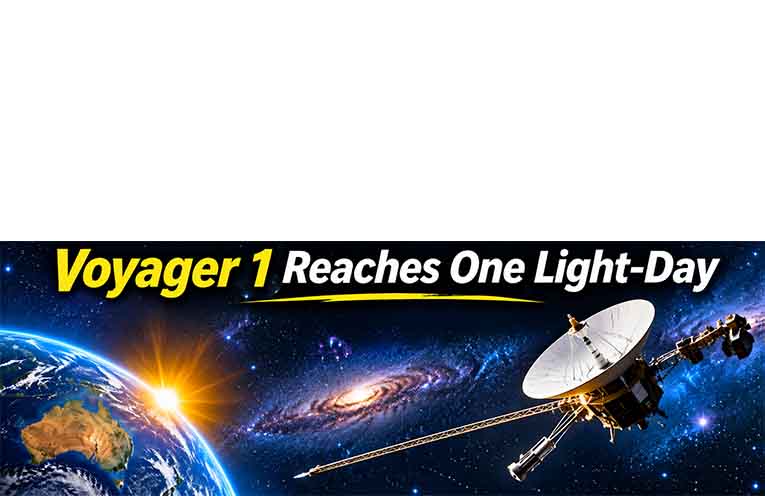
IMAGINE sending a message into space and knowing it will take an entire 24 hours just to reach the spacecraft you’re communicating with. Not because it has stopped listening, but because it has travelled so incredibly far from home.
That extraordinary milestone has just become reality for NASA’s Voyager 1, the most distant human-made object ever launched.
On November 18, Voyager 1 reached one light-day from Earth – approximately 25.9 billion kilometres away. A radio signal travelling at the speed of light will take 24 hours to reach it. A reply will take another 24 hours to get home. Imagine waiting two days for an answer!
Launched on September 5, 1977, Voyager 1 was originally designed to explore Jupiter and Saturn. And what a journey! It revealed Jupiter’s turbulent atmosphere, discovered active volcanoes on its moon Io, and delivered spectacular close-up views of Saturn’s magnificent rings. Its discoveries transformed our understanding of the outer solar system.
But its greatest adventure was still ahead. In August 2012, Voyager 1 became the first human-made spacecraft to enter interstellar space, crossing the heliopause – the boundary where the Sun’s influence gives way to the environment between the stars.
It also carries something extraordinary: the Golden Record. This gold-plated cosmic time capsule contains greetings in 55 languages, music, photographs and sounds of Earth, including birdsong, ocean waves and a mother’s greeting to her child. It’s humanity’s calling card to any intelligent civilisation that might one day discover it.
Another unforgettable moment came in 1990 when, at the request of astronomer Carl Sagan, Voyager turned its camera towards Earth from approximately six billion kilometres away. The resulting photograph, the famous Pale Blue Dot, showed our entire planet as a tiny speck of light. Every human being who ever lived, every war, every civilisation and every triumph existed on that almost invisible dot.
Now, travelling at around 61,000 kilometres per hour, Voyager has made this other historic first. NASA is inviting people worldwide to celebrate after sunset this week by shining a light skyward and flashing the letters V-G-R in Morse code, Voyager’s mission call sign. You can use a mobile phone or flashlight. NASA has even provided an automated flashing signal online.
Of course, Voyager won’t actually see our lights. It’s a symbolic salute to one of humanity’s greatest achievements in scientific exploration. And here’s the astonishing part: nearly 50 years after launch, Voyager 1 is still communicating with Earth, despite ageing equipment, technical problems and dwindling electrical power.
One day, its signals will finally fall silent. But the spacecraft will continue travelling, carrying the sounds, images and greetings of an entire planet into the darkness.
Nearly half a century after leaving home, our little messenger is still going. And what a message it carries: Look what we humans can do.
See Dave’s website www.davidreneke.com for more stories and his Stargazing Tours to Norfolk island.
By David RENEKE