
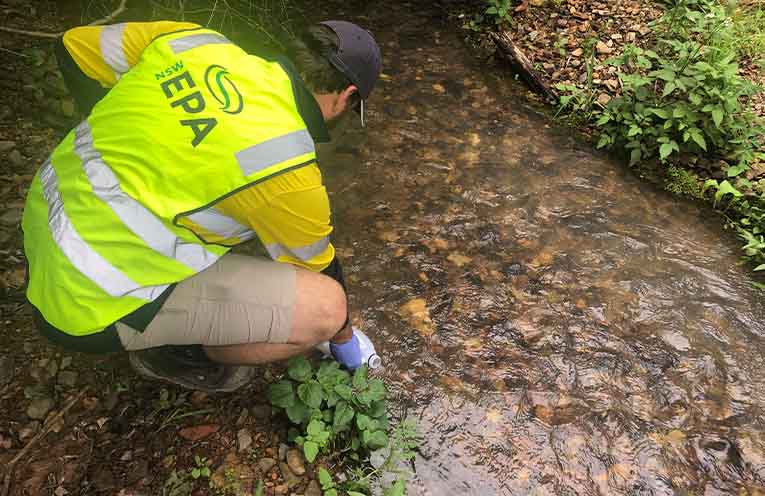
THE NSW Environment Protection Authority (EPA) has ramped up water quality monitoring across the Mid North Coast to better understand pesticide levels in local waterways.
The program focused on key catchments in the Nambucca Valley and Coffs Harbour, combining scientific testing with on-ground compliance activity to address community concerns.

NSW EPA Director Operations John Forcier said the work responded directly to public interest in pesticide use across the region.
“We know pesticide use on the Mid North Coast is a concern for the community and we are maintaining a strong regulatory presence there,” he said.
“We have recently commenced systematic water quality monitoring programs in the Nambucca Valley and Coffs Harbour regions to better understand the presence of pesticides in the region’s waterways.
“These projects have been designed and implemented by local EPA operations staff with good knowledge of local catchments, scientific qualifications and expertise in water quality, investigations and catchment management.”
Mr Forcier told News Of The Area that results so far have returned some pesticide detections in the Coffs Harbour catchment, which was “consistent with monitoring conducted over the last few years”.
He said there were “limited detections in Nambucca”.
Sampling across both regions included recording environmental conditions and testing water for more than 150 pesticides and dissolved trace metals.
According to the EPA, strict quality control procedures ensured samples were collected, handled and transported to laboratories with data accuracy maintained.
In Nambucca, testing at two sites identified a single trace-level detection of the insecticide “imidacloprid” across sampling rounds in July and October 2025.
In Coffs Harbour, pesticides were detected at 14 of 21 sites during initial testing in May 2025, following heavy rainfall that increased runoff into waterways.
Further monitoring in September found detections at three sites, including Dundoo Creek, Willis Creek and Double Crossing Creek.
The EPA will continue monitoring water quality and inspecting horticulture operations, with further data needed to confirm long-term trends across the region.
By Sis HIGGINS