
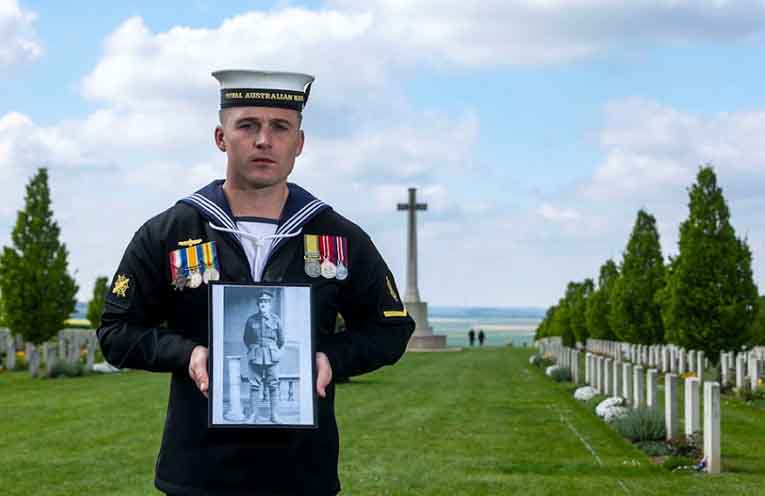
FOR Able Seaman Brenton Knight, travelling to France for Anzac Day this year is not just a ceremonial duty, but the continuation of a legacy that was almost lost to history.
More than a century ago, his great-great uncle, Private Victor Hardaker of the 28th Battalion, Australian Imperial Force, left his home on the north coast to serve his country in World War I.
In 1917, fighting near Bullecourt, he was severely wounded; shot in the head and struck by shrapnel that tore through his body, costing him four fingers.
Returned to Australia, Private Hardaker died of his wounds in 1918 at just 23-years-old.
For decades, his sacrifice remained largely unrecognised; his name was absent from official records, and his story was carried only by family and community memory.
It was not until 2009 that members of the Macksville RSL sub-branch uncovered the oversight, and after years of advocacy from his descendants, Private Hardaker was finally recognised as a war dead, with a rededication service held at his graveside in Eungai Creek in 2011.
Standing in Eungai Creek that day, sounding the Last Post on a bugle, was his great-great nephew, a young Able Seaman Knight.
More than a decade and a half later, Able Seaman Knight will return to the place Private Hardarker’s legacy began; travelling to France as a member of Australia’s Federation Guard, to stand on the ground where his uncle fought and was gravely wounded.
“Honestly, it’s more than a privilege,” Able Seaman Knight said.
“The fact that I’m completing that full circle, from being there when his service was first recognised, to now being able to stand where he fought, it’s something I never thought would happen.”
As the only member of his immediate and extended family to serve, Able Seaman Knight feels he carries forward a legacy that now rests with him, and, he hopes, will continue beyond him.
“It’s a heavy weight, but it’s a weight worth carrying,” he said.
“Knowing that it’s sort of been passed down, and I’m carrying that legacy forward, hopefully one day, when I have kids, they’ll be able to look at that and go, ‘wow’, and want to continue that tradition.”
“That’s something that means a lot to me, that it doesn’t just stop here.”
While Able Seaman Knight’s sense of legacy is deeply personal, he feels it also extends far beyond his family. When he arrives in France, he will do so as a representative of Australia’s connection to those who served, and those who never came home.
“You realise very quickly that it’s not about you anymore,” he said.
“You’re representing something bigger than yourself, you’re representing your country, the ADF and all Australians back home.
“When performing a catafalque party, we are there to not only perform drill movements, but to make those watching feel the drill movements and capture the significance of the occasion. That is what makes our role in this occasion so personally significant.
“For the people back home who can’t make the journey, we’re there for them, we’re there to pay our respects on their behalf, and to do it to the highest standard we can.”
In a few days’ time, standing on the Western Front, where his great-great uncle was mortally wounded, the weight of that representation will be felt more than ever.
“It’ll be incredibly emotional,” he said.
“When you’re there and the silence hits after the Last Post, you picture what they went through.
“You feel that mix of pride and sadness, but also a sense of purpose, knowing you’re continuing their legacy.”
If given the chance to speak directly to the man whose legacy he now carries, Able Seaman Knight’s message is one of thanks.
“I’d say thank you, and sorry that it took so long for your service to be recognised,” he said.
“But most importantly, thank you for what you did.
“On behalf of the family that couldn’t say it at the time, thank you for your service.”
By Captain Annie RICHARDSON