
Share via:
COMMUNITY interest in home renewable energy systems continues to rise across the region.
Homeowners, business owners and government agencies are taking full advantage of the Cheaper Home Batteries Program, which began in July 2025.
Bellingen Shire Council recently installed a battery on the Bellingen Memorial Hall to support its 19kW solar PV system.
“Council investigated installing a battery in 2024, but the numbers didn’t quite stack up,” Bellingen Shire Council General Manager Mark Griffioen said in a statement.
“However, with new battery subsidies being introduced in 2025, Council was able to revisit the project and take advantage of a generous $13,500 battery subsidy, leading to a win-win situation for both economic and environmental outcomes.”
The system will save the Council around $4000 per annum and assist in meeting its 2040 net-zero target.
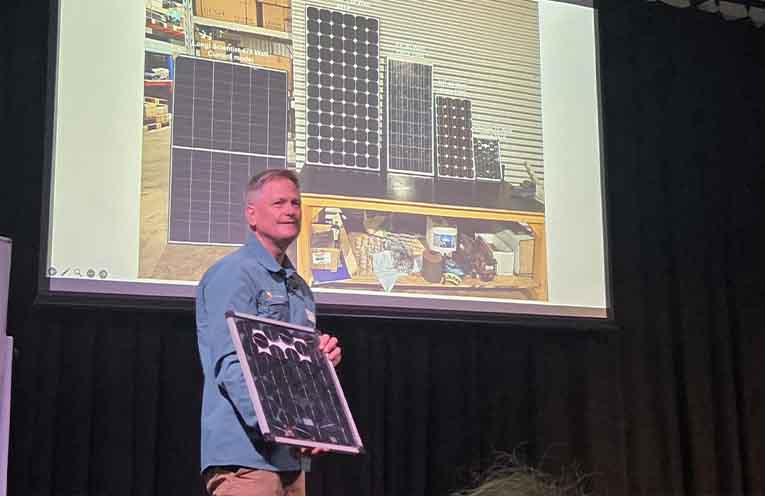
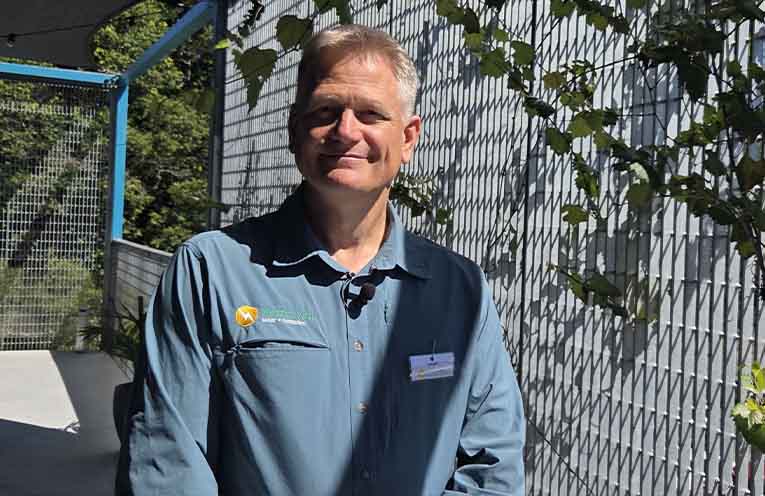
The installation coincided with a talk by renewables expert and BetterVolt owner Geoff Tosio, as part of Council’s “Our Living Coast” series of sustainability workshops.
A passionate educator and former Scout guide of 20 years, Geoff gave his time free of charge to deliver workshops in Dorrigo and Bellingen on the “electrification of everything”.
The Bellingen talk and Q&A on 26 March was attended by around 80 people.
Geoff covered a wide variety of topics including the history of solar panels and batteries, design principles for home energy systems, electric vehicles (EVs), electricity markets and trading, and solar panel and battery recycling.
He explained that home battery systems can have three functions: storing excess energy to use later, black out protection and virtual power plants (VPPs).
VPPs enable homeowners to trade their energy with the electricity market and require an individual to sign up with a VPP provider.
They are designed to assist in avoiding price spikes by harnessing the excess energy stored in individual homes and businesses.
According to Geoff, VPPs are a big part of the solution to Australia’s energy storage problems.
This distributed energy storage arrangement empowers community members through their direct ownership of the asset.
Some of the common myths and misconceptions addressed in the talk included safety concerns around EVs and home batteries, whether gas is a useful transition fuel, and the cost of different types of energy (in a per kWh comparison by the CSIRO, solar was the cheapest and nuclear was the most expensive).
Although there are around 20 types of lithium-ion battery technologies available today, two dominate the market.
These are lithium iron phosphate, which is regarded as the safer of the two, and lithium NMC (nickel manganese cobalt).
Geoff emphasised the need to install a battery that’s the right size for a household and said customers should speak to an expert about finding that “Goldilocks” zone of battery capacity.
The Federal Government is actively discouraging “oversizing” by introducing a tiered system that dramatically reduces the rebate for storage over 14kWh and reduces further again from 28kWh upwards.
The tiered structure begins on 1 May, meaning batteries purchased and commissioned before this date will receive the full rebate across their entire installation – regardless of size.
After that date, a 20kWh battery will cost around $700-$800 more.
Despite fears the program’s budget could run out, the government has increased it from $2.3bn to $7.2bn.
It also hopes to double its initial goal and support two million installations, with 300,000 to 450,000 expected by 30 April, including around 1500–1800 across the shires of Bellingen and Coffs Harbour.
By Jessica MILLER
You can help your local paper.
Make a small once-off, or (if you can) a regular donation.
We are an independent family owned business and our newspapers are free to collect and our news stories are free online.
Help support us into the future.
Share via: