
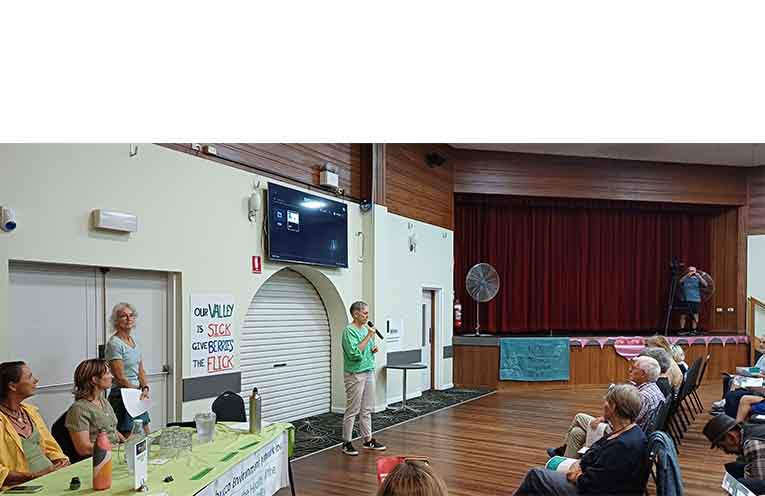
MORE than 130 people attended a public meeting hosted by the Nambucca Environment Network (NEN) at the Macksville Ex-Services Club on Monday night.
NEN has spent the last several years lobbying against intensive blueberry farming in the region.
Speakers at the event included Greens Member of the Legislative Council (MLC) Cate Faehrmann and Nambucca Valley councillors Ljubov Simson and David Jones.
Ms Faehrmann told the attendees that she intended to introduce a private member’s bill to the NSW State Parliament to address the issues of mandatory development consent, buffer zones and environmental concerns to protect neighbouring properties and watercourses from new and current intensive blueberry farming operations.
“What was once small-scale farming has morphed into an industrial model characterised by wholescale clearing of vegetation, plastic netting and tunnels covering hillsides and valleys as far as the eye can see, and extremely high water and chemical use,” she said.
“It risks changing the beautiful Mid North Coast forever.
“I cannot fathom how this industry has gotten away with this for so long,” she added.
Ms Faehrmann also claimed the industry was using ecosystem-destroying chemicals, some which are prohibited in other countries, and that through intensive farming practices, these chemicals are polluting NSW waterways and affecting public health.
“NSW Health is refusing to acknowledge the scale of the issue,” she added.
The Greens water spokesperson went on to explain that she believed many government agencies were not acting in the best interest of the people and reporting processes are “not transparent”.
Ms Faehrmann also presented the meeting with an “extraordinary letter” she claimed to have received from the NSW Minister for Planning, Paul Scully, in response to her questions about the burgeoning blueberry industry and decried the Minister’s comments.
In the letter, Mr Scully said that concerns about the effects of berry farming are “primarily localised to the North Coast” and “would be best addressed through relevant Local Environmental Plans (LEPs) rather than by introducing statewide amendments”.
The minister appeared unaware of issues faced by Nambucca Valley Council, which for the past few years has been seeking to amend its LEP to introduce developmental consent for new farming operations and regulate the industry in response to community concerns.
“I understand few NSW councils have raised concerns about the growth of the blueberry industry and associated protective structures, with Coffs Harbour being the most prominent example,” Mr Scully’s letter stated.
“Other councils in the North Coast, such as Kyogle, have embraced the industry and adopted a Right to Farm Policy (2015).”
“Current advice and submissions also indicate that there are no widespread opposition or regulatory issues elsewhere in NSW,” it said.
At this stage, the Nambucca Valley Council is working on a third draft of its amendment to the LEP to address the issues surrounding intensive horticulture after being knocked back by Mr Scully’s office with what councillors have claimed to be little feedback as to how to improve the document.
A second draft of this amendment, prepared by council staff after consultation with industry, was presented at the Council’s January meeting but was rejected by councillors for not fulfilling the needs of the original amendment.
Other speakers included councillors David Jones and Ljubov Simson, who provided updates on their role in the LEP amendment and expressed their frustrations with the process.
By Ned COWIE