
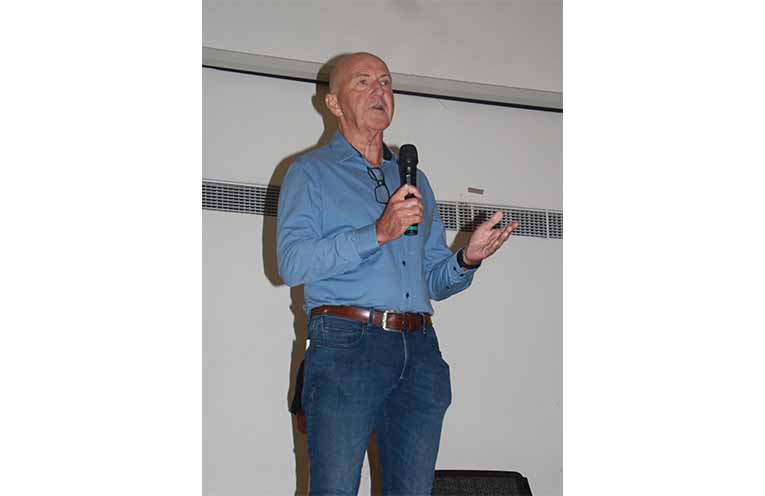
NAMBUCCA Valley and Coffs City councils have affirmed their commitment – and alignment with community mood – to relieve the inhumane conditions facing temporary farm workers in the region.
Last week Council unanimously supported a motion, moved by Councillor Tony Judge, to work with Nambucca Valley Council to submit a motion on addressing modern slavery to the upcoming NSW Local Government Conference.
Anti-Slavery Commissioner for NSW, Dr James Cockayne, has praised this leadership by the councils, who he says are on the frontline of efforts to support vulnerable workers and address modern slavery.
“While the NSW Government has promised to draft labour hire licensing legislation right after the election next March, the 5,500 workers arriving now in the region to pick berries need urgent support and protection from exploitation,” he said.
“I am committed to working with councils, growers, buyers, workers and local communities to make this happen as soon as possible.”
Coffs Councillor Tony Judge has been pushing for action on worker exploitation for nearly a decade.
What began as hearing reports from people working in the region’s horticultural industry has developed into a sustained campaign involving local government, unions, the Commissioner, community organisations, and individuals.
While the extent of the problem was initially documented in 2020 (McKell Institute’s Blue Harvest report) the recent report by the Anti-Slavery Commissioner has brought the concerns to the forefront to the point where, Cr Judge says, they can no longer be ignored.
“Back when I was a candidate for the NSW state election in 2018, people told me about the exploitation of farm workers on the Coffs Coast,” Cr Judge said.
“We can’t keep saying it’s unacceptable and then letting it continue.”
As such, he smiles wryly at the report’s official title – ‘We are all pretending not to see the elephant in the room’.
“It’s time to say, ‘We’ve had enough.This has to stop now’.”
Cr Judge first met with the Anti-Slavery Commissioner Dr James Cockayne when the role was established in 2023 and has continued to work with him to push the issue further up the political agenda.
In that time Cr Judge has come to understand the particular aspects of the region’s blueberry industry that have made it vulnerable to exploitation.
He has used his platform as a Councillor to advocate for action.
He explained that the Coffs Coast is home to more than 65 per cent of Australia’s blueberry crops scattered across hillsides around Coffs Harbour and nearby Grafton and Macksville.
“Farms are often relatively isolated, while the widespread use of labour-hire companies can act to create distance between employers and workers,” he said.
And while the labour-hire system itself is a legitimate part of Australian industrial arrangements, Cr Judge said the lack of a licensing and registration system in NSW had allowed unscrupulous operators to exploit workers and avoid accountability.
“It’s a moving feast with many companies forming, dissolving, then reappearing through dubious practices such as phoenixing,” he said.
“They are unaccountable – they’re not registered – there is no register.”
Cr Judge said some workers had their passports withheld and were threatened with losing their visas if they did not comply with conditions imposed on them. For temporary migrant workers, the fear of losing their visa could make it particularly difficult to challenge exploitation.
He said workers were sometimes discouraged from speaking to others in the community, creating what he described as a “mafia-like code of silence”.
Cr Judge stressed that a community-broad response was essential and it was not simply a matter for government.
He pointed to growing support from the horticultural industry itself, including Berries Australia, which he said was advocating for labour-hire registration and wanted to work with Council to distinguish and support those farmers doing the right thing.
While council does not regulate labour hire or workplace conditions, Cr Judge said local government could see some of the indicators of exploitation through its own responsibilities, including unapproved farm accommodation, overcrowding in housing and waste problems.
Coffs Harbour Mayor Nikki Williams said the intensive horticulture industry was hugely important to the region and it was vital that all aspects of its operations, particularly labour-hire entities, operated legally and responsibly.
“The City is proud of the industry’s growth and success and determined to act to help root out any dodgy operators,” she said, adding that worker exploitation was not isolated to Coffs Harbour, with concerns also raised in other districts and the neighbouring Nambucca Valley.
Nambucca Valley Council has also committed to work with Coffs Council in submitting the anti-slavery motion to the upcoming NSW Local Government Conference.
Councillor Ljubov Simson, who has also been advocating on her councillor platform, affirmed it was timely to remember that temporary migrant workers in Australia had the same legal workplace rights and protections as all other employees.
“There are no longer excuses for retaining a culture of silence on modern slavery,” Cr Simson said.
Like Cr Judge, she sees the issues surrounding worker exploitation and modern slavery as a whole-of-community issue.
“It’s essential that we do everything in our direct power and through advocacy to address all forms of exploitation and human rights abuses in support of a civil society,” she said.
City of Coffs Harbour General Manager Murray Wood said a regional structure was needed to maintain consistent enforcement and ensure responses to labour exploitation were coordinated across the Coffs Harbour and Nambucca Valley regions.
As part of the motion to the NSW Local Government Conference, he has recommended that a central state government agency, working with the Anti-Slavery Commissioner, could coordinate the arrangement.
Cr Judge said the campaign had now reached an important point, with all key parties involved in the local response working towards a common approach – including this important collaborative action by the two councils.
“The exploiters are on notice,” he said.
By Leigh WATSON